New Coil Needs Warm-Up Time After Priming
Part of Coils, priming and burnt hits
A freshly primed coil rarely performs at full strength on the first draw. It needs a short warm-up period before the vapor becomes dense and the draw feels smooth. This guide explains why that period exists, how to work through it, and how to shorten it next time.
Why it happens
A coil head is a metal heating wire wrapped inside cotton wick material. When you prime a new coil, you add e-liquid to the exposed cotton openings by hand. Priming starts the soaking process, but it does not finish it. The cotton layers closest to the wire are still absorbing liquid when you take your first draw, and the cotton itself settles and expands slightly as it saturates.
On the first few firings, the wire heats the surrounding cotton. Liquid moves through the cotton by capillary action, which is the way liquid climbs through narrow fibers without any pumping. Cold liquid is thicker and moves more slowly, so the wick needs a little heat and a little time to reach a steady, even flow.
Some coils have a slight break-in taste at first, and the vapor can feel thin until the wick is fully saturated. This is a normal part of the break-in, not a fault.
A third factor is power. If the device is set to a high wattage on a brand-new coil, the wire heats faster than the cotton can supply liquid. That slows the warm-up because the wick keeps running dry at the contact point where the wire touches the cotton. Starting low gives the cotton a chance to open up and feed evenly.
Step-by-step fix
- Set the device to the lowest wattage printed on the coil. Most coils state a recommended wattage range, on the coil or on its box, such as 30 to 40 watts. Start at the bottom number, not your usual setting.
- Take short, slow draws. Press the fire button for about one second, pull gently, and release. Pause for ten to fifteen seconds between draws so the cotton can pull in more liquid.
- Step the wattage up slowly. After three or four gentle draws, raise the wattage in a step sized to the coil: about one watt below 15 W, two watts between 15 and 30 W, and five watts above 30 W. Take a few more draws at the new setting, then raise it again. Repeat this until you reach your normal wattage.
- Avoid long, repeated draws during the warm-up. Chain-firing a cold, half-wet coil dries the contact point faster than the cotton can recover, which stretches the break-in out.
- Watch for dry or harsh draws. If a draw tastes dry or scratchy, stop firing. Let the tank sit for one minute, then drop the wattage a step and try again. A dry draw means the cotton was not wet enough where it touches the wire, and continuing will damage the coil.
- Give it about fifteen minutes. Most coils settle in after ten to fifteen minutes of light use, roughly the first twenty to thirty short draws.
Prevention
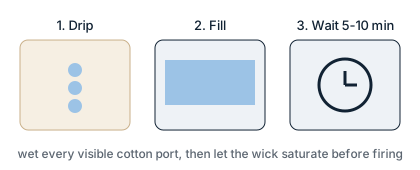
Prime every new coil fully before the first draw. Add a few drops of e-liquid to each exposed cotton opening, install the coil, fill the tank, and let it sit for five to ten minutes. This lets the inner cotton absorb liquid before any heat is applied.
Start every new coil low. Never begin a fresh coil at your usual wattage, even if the coil is rated for it. The cotton needs time to reach a steady flow before it can handle full power.
Keep the tank topped up. When the liquid level drops below the cotton openings in the coil head, the wick can dry out mid-draw. Keeping the tank at least one-quarter full keeps the openings covered and the flow steady.
Use a consistent liquid thickness. E-liquid thickness comes mainly from its vegetable glycerin content. Thicker liquid takes longer to soak into cotton, which lengthens the warm-up period. If you regularly change between thin and thick liquids, expect the warm-up time to change with it.
Store coils clean and dry before use, and replace them when the draw stays weak even after a full break-in. A coil that never settles is usually past its useful life.
This guide is general technical information and is not medical or legal advice.