Gurgling Noise In Your Vape Tank
Part of Leaks, gurgling and flooding
Why it happens
A gurgling noise from a vape tank almost always means liquid has collected where it should not be: inside the central airflow tube, in the coil's wicking ports, or pooled under the coil. When you inhale, air pulls through that pooled liquid, and the bubbling sound is air forcing its way through the fluid.
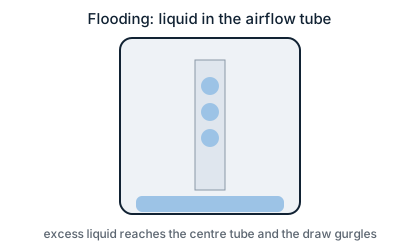
The most common cause is a flooded coil, which happens when more liquid is drawn into the wicking material than the coil can vaporize. Drawing too hard on the mouthpiece pulls extra liquid into the wick. It also happens after a tank sits unused, because the wick keeps absorbing liquid while nothing is being vaporized to dry it out.
Another frequent cause is a pressure problem. A tank relies on a balanced vacuum to hold liquid back and feed the wick at a steady rate. If an o-ring is pinched, a fill gasket is worn, or the top cap is not threaded on straight, the seal weakens and liquid seeps into places it should not reach. A coil that is not screwed in firmly can leak past its base threads too.
Changes in temperature and air pressure also play a part. A warm tank or a sudden change in altitude expands the air inside the tank and can push liquid through the wick, flooding the coil. Finally, a tank that has been overfilled leaves too little air space, so even a small rise in temperature is enough to push liquid into the wick.
Step-by-step fix
Work through these steps in order and stop when the gurgling clears. Keep the tank on the device for steps 1 and 2, and remove it only when you disassemble it in step 4.
- Clear the flooded coil without disassembly. Wrap the tank in a paper towel with the mouthpiece pointed down and flick your wrist sharply downward a few times. This flings pooled liquid out of the mouthpiece and airflow slots. Wipe the outside dry and try a few normal puffs.
- Take a soft test puff. Reassemble the tank, open the airflow, and take a slow, gentle puff at low power. Do not fire the device while blowing into the mouthpiece; that can force hot liquid out of the airflow slots onto your hand.
- Draw more gently. If the gurgling only appears while you vape, you are likely pulling too hard. Take a slow, steady inhale rather than a sharp one. A hard pull creates a stronger vacuum inside the tank, which forces liquid into the coil faster than it can be vaporized.
- Check the coil seating. Disassemble the tank and unscrew the coil. Make sure its base and threads are clean and dry, then screw it back in until snug but not overtightened. A loose coil leaves a gap for liquid; an overtightened one can pinch the o-ring that seals it.
- Inspect the o-rings and fill gasket. Look for any rubber ring that is torn, flattened, pinched, or out of its groove. A damaged seal breaks the tank's vacuum and allows flooding, so replace any worn o-ring. Many tanks ship with spares.
- Dry the chimney and airflow. The chimney is the central tube running from the coil up to the mouthpiece. Twist a corner of a paper towel into a thin point and wipe inside the chimney and the airflow slots at the base. Liquid left in these passages will keep gurgling.
- Verify the fill method. When refilling, keep the airflow closed, fill only to the marked maximum line, and close the top cap promptly before reopening the airflow. Filling past the line reduces the air space the tank needs to hold its vacuum.
If the coil has been flooded repeatedly or tastes burnt after clearing, install a fresh coil and prime it correctly before use.
Prevention
The easiest way to avoid gurgling is to draw softly and steadily. A gentle inhale matches the rate at which the wick can feed liquid, so the coil is not overwhelmed.
Store the tank upright whenever possible, especially overnight. A tank lying on its side lets liquid pool against the coil and airflow openings for hours, and the first puffs in the morning will gurgle.
Close the airflow before refilling and reopen it only after the top cap is sealed. This keeps the internal pressure stable during the fill and prevents liquid from being pushed into the coil.
Check the o-rings and the coil's seating each time you clean the tank. Catch a worn seal before it fails, and always snug the coil down fully after cleaning.
Match your power setting to the coil's recommended wattage range, printed on the coil or its box. A coil run too low cannot vaporize liquid fast enough, so the wick floods. Running in the recommended range keeps vaporization ahead of the wick's liquid supply.
Finally, if you change altitude while driving through the mountains or flying, expect brief gurgling until the tank's internal pressure equalizes. Keep the tank upright and the airflow closed during the trip, and open the airflow only when you are ready to vape.
This guide is general technical information and is not medical or legal advice.